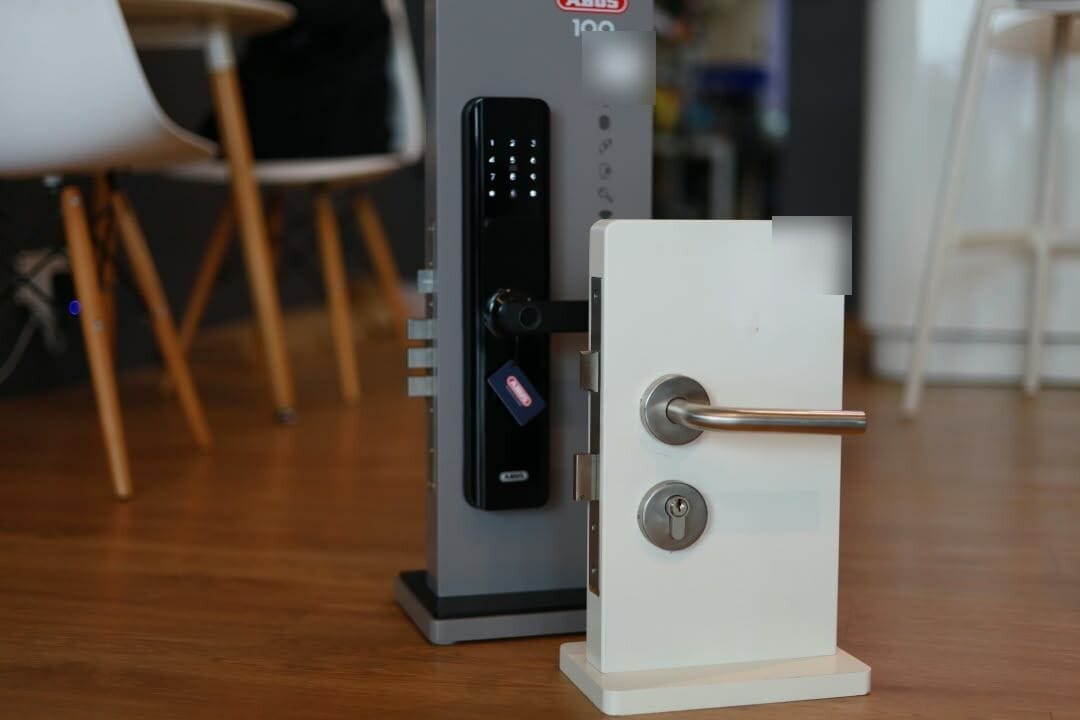
Smart lock vs traditional lock: which is actually stronger? Neither, by itself.
A door lock is only as strong as its weakest part. Strength comes from the bolt, the strike plate, the screws, the door and the frame. It also comes from good fitting. These matter more than whether you open it with a key or a fingerprint.
In this post, we explain how each kind of lock gets beaten. Then we show you how to check a lock’s strength before you buy.
Smart lock vs traditional lock: which is actually stronger?
Short answer: In tests, they come out about the same. A smart lock is not stronger just because it is smart.
Consumer Reports, a US group that tests products, tests both types of locks in the same way. Their testers swing a 100-pound steel ram at a door with the lock fitted. They also drill and pick the locks. A few good kicks beat almost every lock they rated. So did a couple of minutes with a cordless drill. That goes for normal deadbolts, keypad locks and smart locks (Consumer Reports).
They say smart locks are “just as susceptible to forced entry” as normal locks. Smart locks may also be open to digital hacks (Consumer Reports).
Practical takeaway: Don’t buy a smart lock because you think it is tougher. Judge any lock by its parts and its fitting.
What makes a door lock strong or weak?
Short answer: The parts around the lock matter as much as the lock. A strong lock on a weak frame is still weak.
The weak spot is often the strike plate. This is the metal plate on the door frame that the bolt goes into. Consumer Reports kick-tested almost two dozen locks. Only six held up with the parts they came with. Then testers fitted a box strike. This is a stronger metal box for the bolt, held with four 2-inch screws. After that, every lock was very hard to kick in (Consumer Reports).
Consumer Reports found many strike plates come with short screws. These hold only the thin door frame, not the wall behind it. They also warn that weak doors, like hollow doors, may break before the lock does. They advise 3-inch screws for the strike plate and the hinges (Consumer Reports).
Practical takeaway: Open your door and look at the frame. If the screws are short, or the plate is thin, fix that first. It may help more than a new lock.
How traditional locks get beaten
Short answer: By force, or by attacking the key part. The key part is called the cylinder. It is the small barrel you put the key into.
There are a few common tricks. Picking means moving the pins inside with small tools. Bumping means hitting a specially cut key to jump the pins. Snapping means breaking a cylinder that sticks out from the door, so the lock can be opened. A West Yorkshire Police leaflet looked at attacks on these cylinders. It says they made up about 20–25% of all burglaries in its area. In 40% of these, the burglar did not get in (West Yorkshire Police leaflet).
London’s Metropolitan Police advise a cylinder rated TS 007 3-star. They say these locks protect against snapping, drilling and bumping (Met Police). Police also say a cylinder should not stick out past the door or handle (West Yorkshire Police).
Practical takeaway: Look at your key cylinder from outside. If it sticks out past the handle, ask a locksmith about a shorter, tested one.
How smart locks get beaten
Short answer: In the same ways as normal locks, plus a few new ones. A smart lock has a body, a bolt and often a backup key. It also has electronics.
Forced entry still works. Consumer Reports found many smart locks are still open to drilling and picking (Consumer Reports). Many smart locks also have a key override. This is a hidden keyhole for when the battery is flat. That keyhole is a cylinder too. So it can face the same picking and bumping tricks.
Then there is the electronic side. In 2025, university researchers tested 18 Bluetooth smart locks. They found 14 were still open to attack. Some attacks let a stranger in. Others stop the lock working, or hide from the entry log (Lin et al., IEEE Transactions on Consumer Electronics).
There is good news too. A UK consumer group notes that smart locks often lock out someone who keeps guessing wrong codes (Which.co.uk?utm_source=wordpress&utm_medium=Fine+Lock+Shop+-+Smart+Door+Lock+%26+Locksmithing&utm_campaign=publer?). We cover hacking in more detail in Are smart door locks safe?
Practical takeaway: Check the backup keyhole, not only the keypad. Keep the lock’s software updated, and use a long, unique app password.
How to check a lock’s strength before you buy
Short answer: Look for an independent test rating. Don’t rely on words like “heavy duty” on the box. Terms like C-class cylinder, Anti-pick, Anti-kick, Anti-burglar etc are all self-made-claim. How do they know if it was never tested?
In the US, the group BHMA grades many locks from Grade 1 to Grade 3. Grade 1 is the highest (BHMA). Products are tested by independent labs to earn the BHMA Certified mark (BHMA). Consumer Reports says these grades seem to match its own test results. But the box doesn’t always show the grade (Consumer Reports).
In the UK, look for TS 007 stars or Sold Secure Diamond (SS312) on cylinders. West Yorkshire Police recommend both (West Yorkshire Police). For smart locks, Sold Secure, a UK testing house, made a standard called SS504. It tests the lock against physical attack. It tests the cylinder to EN 1303, a European cylinder standard, if there is one. It also checks the electronics and the online security (Secured by Design).
Practical takeaway: Ask the shop which test the lock has passed. If no one can tell you, treat it as untested. Treat any claim without a test result as unproven.
When is each one the stronger choice?
Short answer: Pick the lock with better tested parts and better fitting. The type comes second.
A traditional lock wins when it has a tested cylinder and a solid box strike. It has no battery, app or software to fail. A smart lock wins when it has a tested body, strong bolts and a tested backup cylinder. It also has a plus that keys don’t. You can delete a code when someone moves out, without changing the lock (Consumer Reports).
The door matters as much as the lock. On a metal grill, the lock must be made for outside use. See Can you put a smart lock on a grill door? Worried about power cuts or Wi-Fi? Read Will a smart lock still work during a blackout? and Do smart locks work without Wi-Fi?
Practical takeaway: Choose smart or key by how you live. Then make it strong with tested parts and a proper fitting.
FAQ
Is a smart lock stronger than a normal lock?\
Not by itself. Consumer Reports found both kinds can be kicked in or drilled. The bolt, strike plate, screws and door decide the strength.
Can a smart lock be broken easily?\
A poorly made or poorly fitted one can. In one 2025 study, 14 of 18 Bluetooth smart locks were still open to attack. Choose a tested model and have it fitted well.
What is the strongest door lock?\
There is no single strongest lock. Not even a bank vault lock can stop every attack forever. Look for a high independent rating, such as BHMA Grade 1, TS 007 3-star or Sold Secure. Fit it with a box strike and long screws.
Can burglars pick a smart lock?\
They can pick its backup keyhole if it has one. Many smart locks have a normal key cylinder for flat batteries. Ask how well that cylinder is tested.
Does a stronger strike plate really help?\
Yes. Consumer Reports fitted a box strike with longer screws. After that, every lock was very hard to kick in.
Closing tip
Try this simple check at home. Open your front door and look at the frame where the bolt goes in. Is the plate thin? Are the screws short? Then look at the key cylinder from outside. Does it stick out? These three things tell you more about your door’s strength than the lock’s brand.
Practical takeaway: Not sure how strong your door is? Bring a photo of your door, frame and lock to Fine Lock Shop Kuching (3rd Mile). We are at Ground Flr, Lot 4863, Jalan Datuk Amar Kalong Ningkan, 93250 Kuching. We are open Mon–Fri 9:00am–5:30pm and Sat 9:00am–2:00pm. Sundays and public holidays are for emergencies only. You can WhatsApp us at 082-288422 or email finelockshop@gmail.com.
Leave a Reply